

MP4 videos may become corrupted, inaccessible, or accidentally deleted. If you cannot open an MP4 file or find that your video has disappeared, this guide provides practical methods to repair corrupted MP4 videos and recover lost MP4 files on Windows.
Quick Solutions to MP4 Video Recovery/Repair:
| Problem | Solution |
| MP4 deleted accidentally | Check Recycle Bin or use data recovery software |
| MP4 cannot open | Try video repair tools or VLC media player |
| MP4 has playback errors | Check codecs or convert the format |
Why Are MP4 Files Lost or Corrupted?
Before starting to learn how to recover MP4 videos and repair MP4 files, you need to know what causes MP4 files to be missing or corrupt. Here are some common reasons.
- Incomplete download or transfer: If an MP4 file is interrupted during downloading, uploading, or transferring due to a network problem or application error, the file may become corrupted.
- Improper file operations: Incorrect video editing, changing file extensions, renaming files while they are in use, or using unreliable tools may damage MP4 files. Accidental deletion or emptying the Recycle Bin can also cause MP4 videos to be lost.
- Drive issues: Hard drives and SSDs can develop bad sectors over time, and physical damage or extreme environments can also cause them to be damaged. If an MP4 file is stored in these damaged areas, parts of the file may become unreadable or even the entire video disappears.
- Backup failure: If backup procedures fail or are not performed correctly, video files may get lost if the original copies have been deleted or corrupted.
- Premature ejection: Removing a USB drive, SD card, or external hard drive that holds the MP4 videos without using the Safely Remove Hardware option may interrupt the writing process, resulting in corrupted or lost MP4 files.
- Virus or malware infection: Viruses, ransomware, or other types of malware may infect, corrupt, delete, or encrypt MP4 files, making them inaccessible or completely deleted.
How to Perform MP4 Video Recovery on Windows?
How to recover MP4 files when your files are missing? Here two methods can help you.
Method 1: Recover MP4 Videos From Recycle Bin
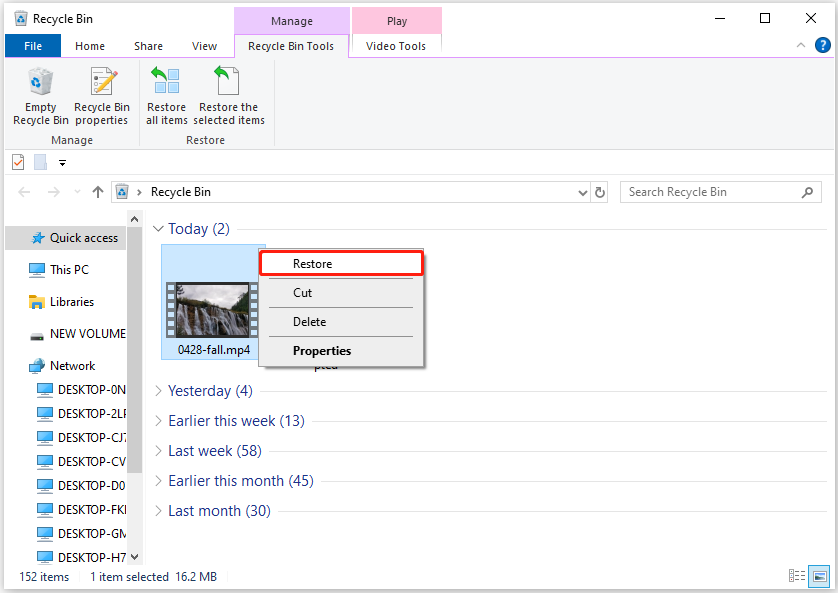
If your MP4 video files are missing, you need to check the Recycle Bin first. Sometimes, you may delete MP4 files from your desktop or folders unintentionally. Fortunately, they are not actually deleted but placed in the Recycle Bin. They are not permanently deleted until you delete the files in the Recycle Bin.
Open the Recycle Bin and check if the MP4 video you want to recover is there. If yes, right-click it and choose Restore. Then you can find it in its original location.
Method 2: Recover Your MP4 Files With MiniTool Power Data Recovery
If you have confirmed that your videos have gotten lost permanently, you need a data recovery tool to recover them.
MiniTool Power Data Recovery allows you to recover MP4 videos lost due to various reasons such as accidental deletion, OS crash, partition formatting, hard drive failure, partition loss, virus attack, and so on.
Moreover, MiniTool Power Data Recovery supports recovering files from a variety of file storage devices, including internal hard drives, external hard drives, SD cards, USB flash drives, etc.
Now you can get MiniTool Power Data Recovery Free and recover up to 1GB of files without charge.
MiniTool Power Data Recovery FreeClick to Download100%Clean & Safe
Step 1: Launch MiniTool Power Data Recovery.
If the MP4 files are stored on a USB drive or SD card, you need to connect it to your computer first. Then, open this MiniTool data restore tool, and it will automatically recognize the USB drive. If not, click the Refresh button from the upper right corner to refresh the device list.
Step 2: Select the target drive to scan.
Select the drive where your lost MP4 videos were stored and click Scan. If you know the exact location of the deleted MP4 videos, you can choose a specific folder or location to scan, which can save time compared with scanning the entire drive.
Here we take scanning the desktop as an example.

Step 3: Find the needed files and recover them.
When the scanning is complete, you can use Type or Filter to find your MP4 files more quickly. Moving on to the Type category list, you can view all MP4 videos individually under Audio & Video. The Filter feature enables you to filter listed files by file modification date, file size, and file category.


Choose the files you need and hit Save. Then you need to select a directory to save the recovered files and select OK. Be careful not to save the recovered files in the same storage location where the lost data were stored to prevent file overwriting.
If you run out of 1GB of free recovery, you’ll need to upgrade the software to get unlimited data recovery capacity.
How to Fix Corrupted MP4 Video Files on Windows?
Method 1: Fix Videos With VLC Media Player
VLC media player is a free, open-source multimedia player developed by the VideoLAN project. It is renowned for its ability to play a wide range of audio and video file formats without needing additional codecs.
Here are the steps to fix corrupted videos by using the VLC player.
Step 1. Make a copy of your corrupted MP4 video and change the file extension to .avi.
Step 2. Open VLC Media Player and click Tools > Preferences.
Step 3. Go to the Input/Codecs tab, expand the Damaged or incomplete AVI file drop-down menu, select Always fix, then click Save.
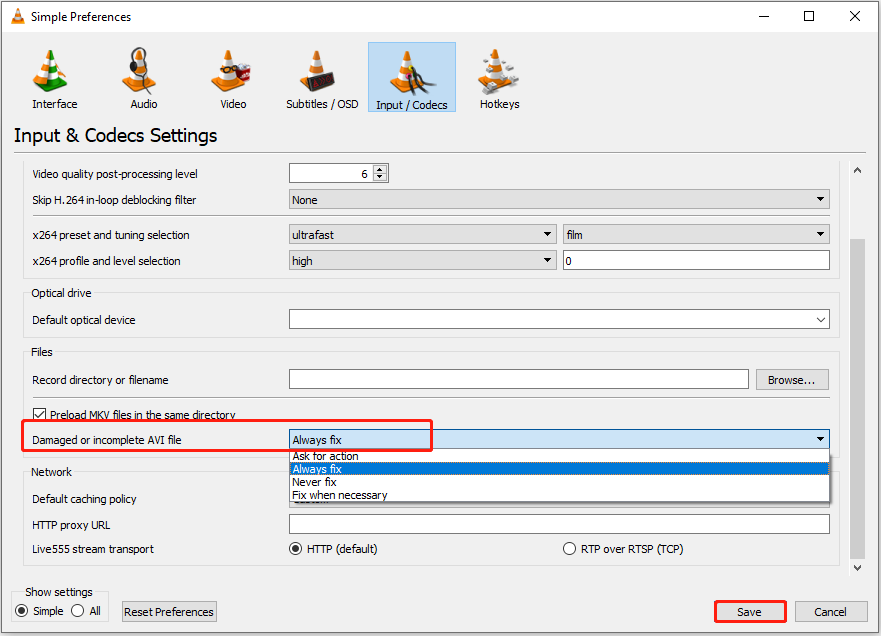
Step 4. Right-click the renamed AVI file and open it with VLC Media Player to play it.
Method 2: Use a Video Repair Tool
If VLC Media Player does not fix the MP4 file, a video repair tool can help analyze and fix common issues, such as damaged headers, missing metadata, or corrupted video indexes.
You can use Stellar Repair for Video to repair corrupted MP4 files.
Stellar Repair for VideoClick to Download100%Clean & Safe
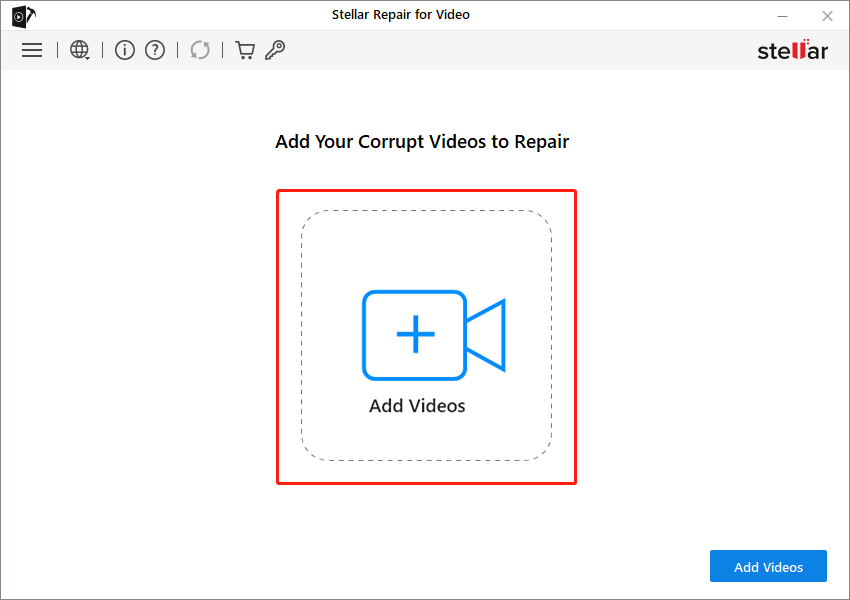
Step 1. Launch Stellar Repair for Video, then click Add Videos to add the corrupted MP4 file.
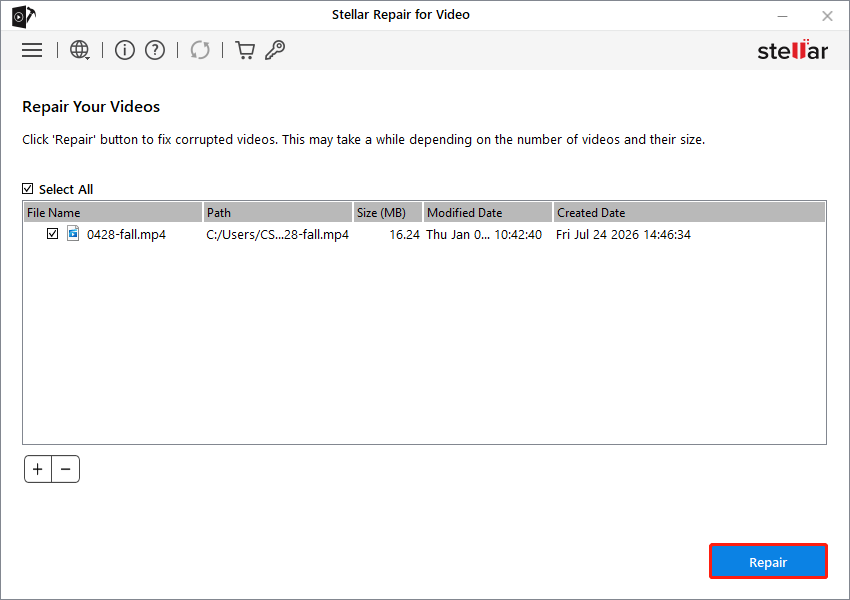
Step 2. Click Repair to fix corrupted videos.
Step 3. Click Save Repaired Files to save your MP4 videos.
How to Prevent Video Files From Getting Lost or Corrupted?
To prevent video files from getting lost or corrupted, it’s necessary to implement a combination of good practices in file handling, storage, backup, and security. Here are some useful strategies:
- Complete transfers and downloads: Ensure file transfers or downloads are fully completed before disconnecting storage devices or closing applications. You can use download managers to resume those interrupted downloads.
- Safely eject storage devices: Use the eject option on your system before unplugging USB drives or external hard drives.
- Use high-quality storage devices: Purchase reputable and high-quality storage devices such as SSDs, HDDs, USB drives, and SD cards. Replace the storage device promptly to avoid using old or unreliable storage media.
- Back up videos regularly: Store copies of your video files in multiple locations, such as external hard drives, cloud storage, or network-attached storage. Also, you can use professional file backup software like MiniTool ShadowMaker to schedule regular, automatic backups. Ensure backups are consistent and verify their integrity periodically.
- Verify checksums for the video files: Use checksum tools to create and verify checksums for your video files, ensuring they haven’t been altered or corrupted during transfer or storage.
- Edit the video correctly: Learn how to correctly perform video editing and cutting operations, and do not rename the files improperly.
Conclusion
This article gives you a detailed guide to help you recover and repair MP4 files on Windows. Perform the above methods to get your video files back now!
Recover MP4 Videos FAQ
About The Author

Position: Columnist
Shirley holds a bachelor’s degree in English and has been an editor at the MiniTool Team for many years. She specializes in IT-related content, with a focus on data recovery, file backup, disk management, and other technical topics. She is committed to delivering clear, accurate, and practical solutions to help users resolve common computer issues.
User Comments :