

The error “CHKDSK is not available for RAW drives” occurs when Windows cannot recognize the file system of the drive. This guide explains why CHKDSK cannot repair RAW drives, how to recover data from a RAW drive, and how to fix the drive after data recovery.
Quick Answer:
CHKDSK cannot repair a RAW drive because Windows cannot recognize its file system. When a drive becomes RAW, the file system is damaged, missing, or incompatible with Windows.
To fix a RAW drive without losing data, recover files first, then format the drive to rebuild a new file system.
What Does “CHKDSK Is Not Available for RAW Drives” Mean
When you fail to access a partition on your data storage device, you may consider utilizing the CHKDSK command tool, a Windows built-in utility, to fix the partition issue. However, running the CHKDSK command fails to resolve the issue, coming with an error message: The type of the file system is RAW. CHKDSK is not available for RAW drives.

As indicated in the error message, the file system should be set to RAW. To verify this, you can open Disk Management on your computer and locate the proper partition in the partition list. Different from other partition displays, the problematic partition is labeled with RAW.

Why Does a Drive Become RAW
Generally, there are three reasons for a RAW drive, such as the existence of an unknown or corrupted file system, the absence of a file system following formatting, and the presence of a file system that is not recognized by the computer.
| Cause | Description |
| File system corruption | The NTFS/FAT32/exFAT structure becomes damaged due to unexpected shutdown, virus infection, or improper operations. |
| Bad sectors | Physical damage prevents Windows from reading file system information. |
| Interrupted formatting | Formatting interrupted by power loss or system failure can leave the partition unreadable. |
| Unsupported file system | Windows cannot recognize file systems created by other operating systems. |
Can You Convert RAW Drive to NTFS Without Formatting
You may think about converting the RAW file system to NTFS and then rescuing files. However, Windows cannot directly convert a RAW file system to NTFS because the original file system structure is unavailable. The convert command only works with supported file systems such as FAT or NTFS.
When a drive is RAW, Windows returns: Convert is not available for RAW drives.

You can’t fix RAW drive without format when an error message indicating that CHKDSK is not available for RAW drives is received.
How to fix CHKDSK is not available for RAW drives:
- Recover important files from the RAW drive
- Format the RAW drive using built-in tools or a third-party formatter

Step 1. Recover Data from a RAW Drive Using MiniTool Power Data Recovery
Recovering data from a RAW drive should be the first step before formatting or attempting other fixes. Professional data recovery software can scan the RAW drive, locate recoverable files, and restore important data without modifying the original drive.
MiniTool Power Data Recovery supports RAW drive recovery from various storage devices, including internal and external hard drives, USB drives, SD cards, and memory cards. It can help recover documents, photos, videos, audio files, and compressed folders.
Besides RAW drive recovery, this free recovery tool can also help retrieve data from formatted or lost partitions.
Use the free edition to recover 1 GB of files for free.
MiniTool Power Data Recovery FreeClick to Download100%Clean & Safe
>>1. Choose the target partition to scan
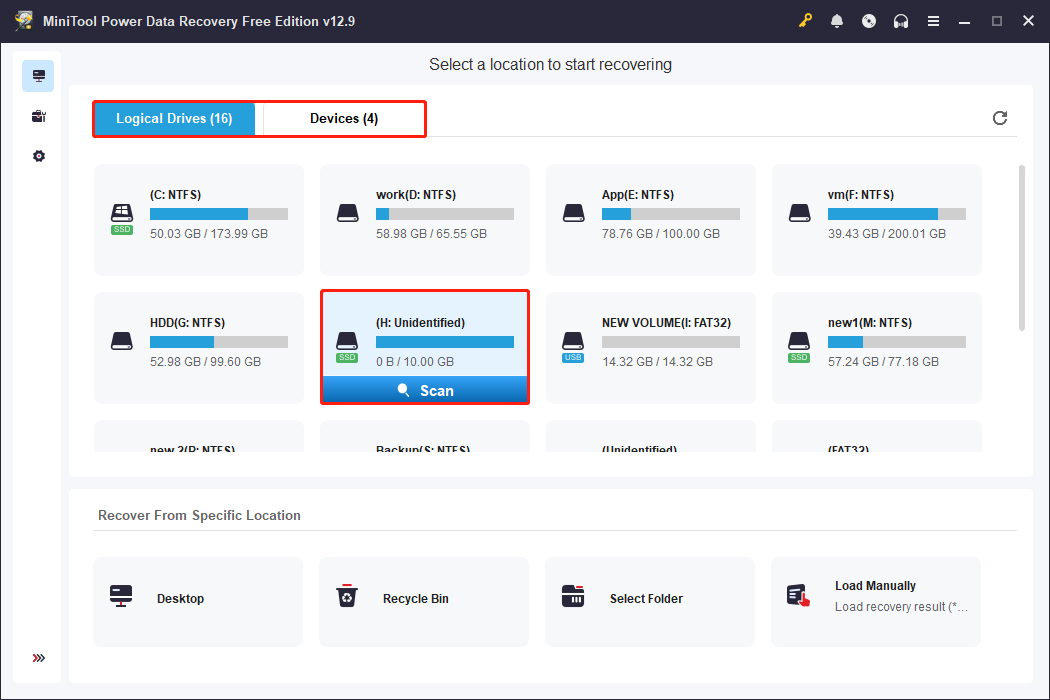
Launch the recovery software to enter its main interface. All partitions detected will be listed under Logical Drives. Choose the RAW partition (shown as Unidentified) and click Scan.
If the whole disk is RAW, you can change to the Devices section to scan the entire disk.
Choose the RAW partition and click Scan. If the whole drive is RAW, you can change to the Devices section to scan the entire drive, which may require a longer scan duration.
>> 2. Locate the files on the result page with different features
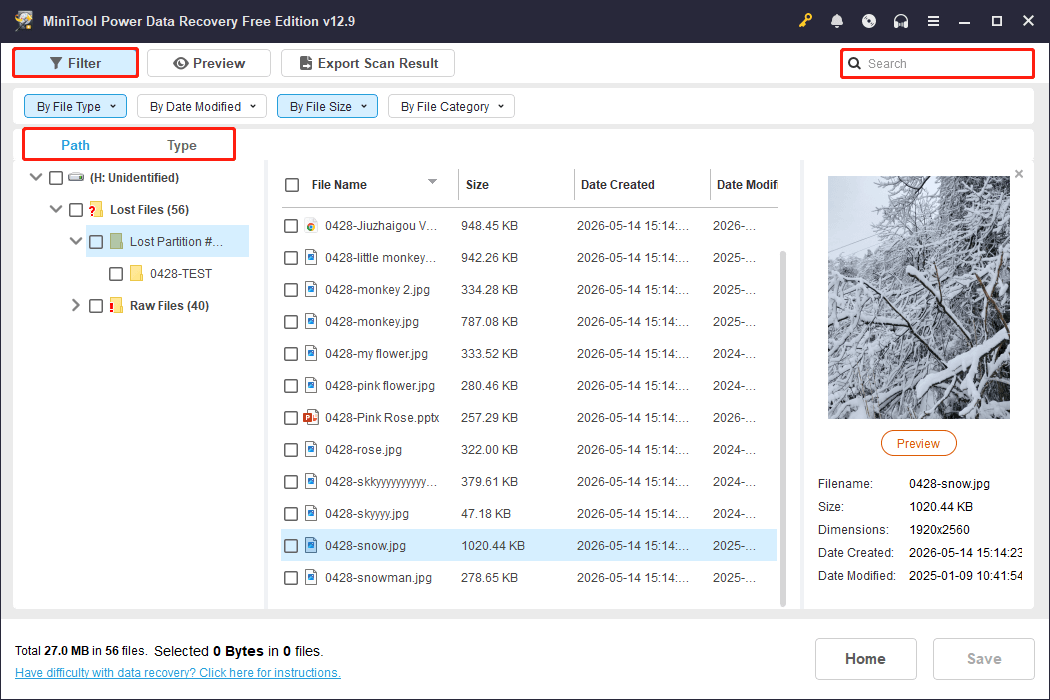
After scanning, all files are listed under the Path tab by default. You can find the required files by expanding folders layer by layer.
Alternatively, switch to the Type tab to find files according to their types, like Document, Picture, Audio & Video, etc., and file formats, such as DOCX, NEF, WMA, MP4, and more.
When thousands of files are listed here, browsing the file list to locate target items is a tiresome process. Hence, you can try the Filter and Search features.
- Search: Search for specific files by using partial or complete file names.
- Filter: Filter files by file type, size, modification date, and category.
>> 3. Restore files from the RAW drive
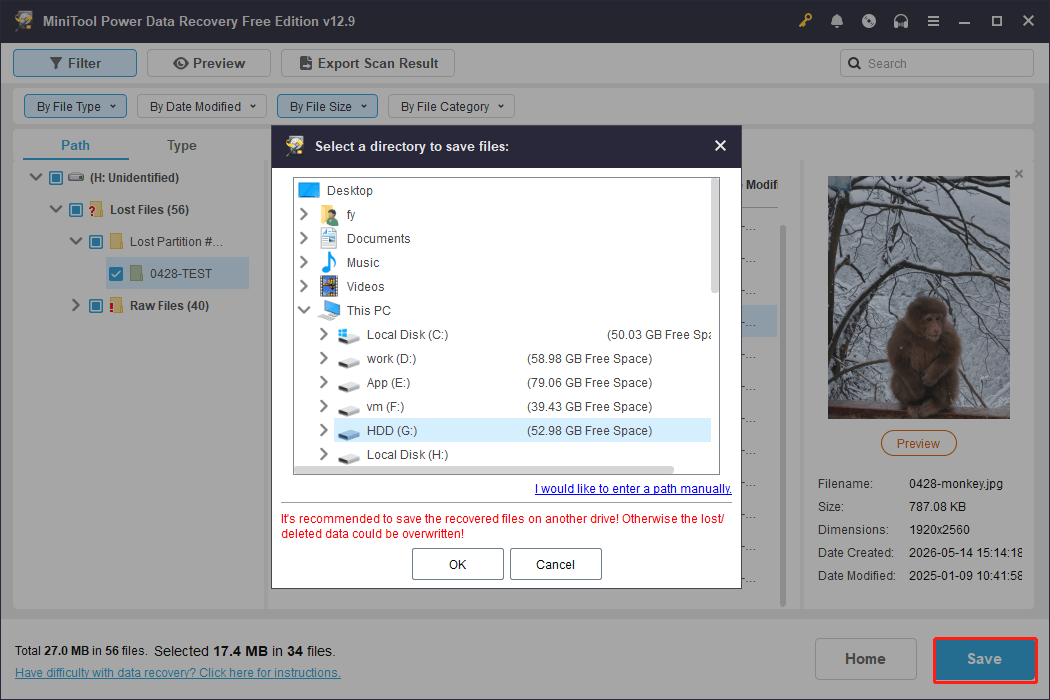
Double-click the files or click the Preview button to verify the file content. The free edition of this software provides only 1 GB of free file recovery capacity; thus, the Preview function is an essential tool for ensuring the accuracy of file recovery.
Once confirming the files that you want to restore, select them and click Save to store them.
Step 2. Format the RAW Drive for Normal Access
After successfully recovering files from the RAW drive, you can now format the drive to make it accessible again. Here are three different methods for you to format the RAW drive on Windows. Choose the format approach that is feasible in your case.
>> Format the RAW drive via File Explorer
File Explorer is a file manager application that allows you to access and manage file systems. When the file system of a partition or an inserted device turns to RAW, you will be informed to format the device once connecting it.
Follow the next steps to format the drive in File Explorer.
Step 1. Press Win + E to open File Explorer.
Step 2. Choose This PC at the left sidebar and right-click on the target drive at the right pane.
Step 3. Select Format from the context menu. You need to choose a compatible File system, set the Volume label, and tick Quick Format in the following configuration window.

Step 4. Click Start to begin the format process.
>> Format the RAW drive using Command Prompt
You can also fix RAW drive with CMD on your computer. For those who prefer to execute command lines to complete tasks, running the Command Prompt is a portable way. Here is how to format the RAW drive by using the diskpart command line.
Step 1. Press Win + R to open the Run window.
Step 2. Type cmd into the dialog and press Shift + Ctrl + Enter to run Command Prompt as administrator.
Step 3. Type the following command line and press Enter at the end of each command line.
- diskpart
- list disk
- select disk * (You should replace * with the correct number of the RAW drive)
- clean
- create partition primary
- format fs=NTFS (This command line will format the drive with the NTFS file system. If you want to format it to other file systems, such as FAT, the command line should be format fs=FAT.)

Wait for the command line to complete. Afterward, you can try to access the drive again.
>> Format the RAW drive with MiniTool Partition Wizard
Additionally, you can try some professional third-party partitional managers to format the RAW drive. MiniTool Partition Wizard is an ideal option. This partition master can not only format the drive but also resize, wipe, and clone partitions and contains other robust functions. To format a RAW drive, you can get the free edition of this software by clicking the download button below.
MiniTool Partition Wizard FreeClick to Download100%Clean & Safe
Step 1. After downloading and installing this software on your computer, you can launch it. If you need to format an external device, connect it to your computer and click the Refresh button to let the software detect the device.
Step 2. Select and right-click on the RAW partition and choose Format. Set the Partition Label and File System in the prompt window.

Step 3. Click OK. You can preview the disk status after formatting on the main interface. If there is no mistake, click Apply at the left corner to complete the suspend process.
Bonus Tip: Back up Files to Protect Data
Data recovery always happens when files are lost or data storage devices become inaccessible or formatted. While data recovery utilities have a high success rate, it is important to note that this is not a 100% solution. To safeguard against data loss in advance, you need to back up crucial files to different devices. Here are three different backup options.
1. Copy and paste files to another place.
This approach is used when there are only a few files. You can copy and paste or drag and drop those files to a new destination. When there are numerous files, this method may take a longer time and probably cause duplicate files.
2. Link the target folders to cloud storage.
Various cloud storage is available nowadays. You can connect the folders where you save important files to cloud storage, such as OneDrive, Google Drive, Dropbox, etc. Cloud storage will be automatically refreshed in accordance with the linked folders. However, there is a backup capacity limit for the free edition of those cloud storage services. You need to free up your cloud storage on a regular basis.
3. Back up files with backup utilities.
You can back up files to other physical devices with the help of backup utilities, including Windows built-in tools and third-party software.
File History, a Windows-embedded tool, requires you to enable the function manually and add folders to the backup list if they are not included by default.
MiniTool ShadowMaker, a professional backup software, is able to back up files, folders, partitions, and disks regularly and with different backup types, including full backup, incremental backup, and differential backup. You can get this tool to experience backup features for free within 30 days.
MiniTool ShadowMaker TrialClick to Download100%Clean & Safe
You can choose one backup method based on your requirements. File backups are the most direct and easiest way to get files back in whatever situation.
Final Words
RAW partitions appear because of corrupted file systems, virus attacks, bad sectors, and other reasons. When you try to repair the partition with the CHKDSK tool, you will find that CHKDSK is not available for RAW drives. This post shows you how to recover data from a RAW drive as well as how to fix a RAW drive.
Additionally, remember to back up files to protect your vital files. If you have any problems using MiniTool software, please feel free to contact us via [email protected].
About The Author

Position: Columnist
Shirley holds a bachelor’s degree in English and has been an editor at the MiniTool Team for many years. She specializes in IT-related content, with a focus on data recovery, file backup, disk management, and other technical topics. She is committed to delivering clear, accurate, and practical solutions to help users resolve common computer issues.
User Comments :