

Various factors can lead to memory card problems. This guide explains common SD card errors, their causes, and practical fixes on Windows 11/10. If the card contains important files, learn how to recover your data first and safely repair or format the SD card.
SD cards can develop different problems when they are used in cameras, computers, game devices, phones, and other digital devices. Common SD card errors include SD card not showing up, SD card is corrupted, SD card is write-protected, SD card needs to be formatted, and SD card has a RAW.
Quick Answer: What Should I Do When My SD Card Shows an Error
If your SD card shows an error on Windows, follow these steps in order:
- Stop using the SD card.
- Reconnect the card and check the card reader or adapter.
- Try the SD card on another card reader or computer.
- Check whether Windows detects the card in Disk Management.
- If the card is accessible, back up important files immediately. If the files are inaccessible but the card is detected, use data recovery software before formatting or repairing the card.
- After your data is safe, try SD card repair methods such as repairing file-system errors or formatting the card.
Common SD Card Errors and What They Mean
The exact message depends on the device and operating system. However, most SD card problems fall into a few common categories.
| Error or symptom | What it may indicate | What to do first |
| SD card is not recognized | Reader, connection, driver, or hardware problem | Try another reader or computer |
| SD card is not showing up | Missing drive letter, partition loss, or detection failure | Reconnect the card or check Disk Management |
| SD card is not accessible | File-system corruption or damaged partition information | Recover important data first and check for file system errors |
| SD card needs to be formatted | Windows cannot correctly read the file system | Do not format before recovering data |
| SD card is corrupted | File-system or storage-media problems | Recover data and format the card |
| SD card is write-protected | Physical lock, read-only state, or card failure | Check the lock switch and write status |
| SD card has a read/write error | Connection, file-system, or hardware problem | Test another reader or format the card |
How to Recover Data from an SD Card with Errors
If Windows detects the SD card but you cannot open it, or files become inaccessible, SD card recovery software may be able to recover the files.
MiniTool Power Data Recovery can scan all local storage devices that are recognized by Windows and search for deleted or inaccessible files. Supported file types include photos, videos, audio, documents, and other data.
You can get the free edition of this software to scan the SD card and check if it can find the files. You can recover 1 GB of files for free.
MiniTool Power Data Recovery FreeClick to Download100%Clean & Safe
Step 1. Choose the SD Card to Scan
Run MiniTool Power Data Recovery to enter its main interface. Choose the target SD card partition under the Logical Drives section to scan, or switch to the Devices tab to scan the SD card directly.
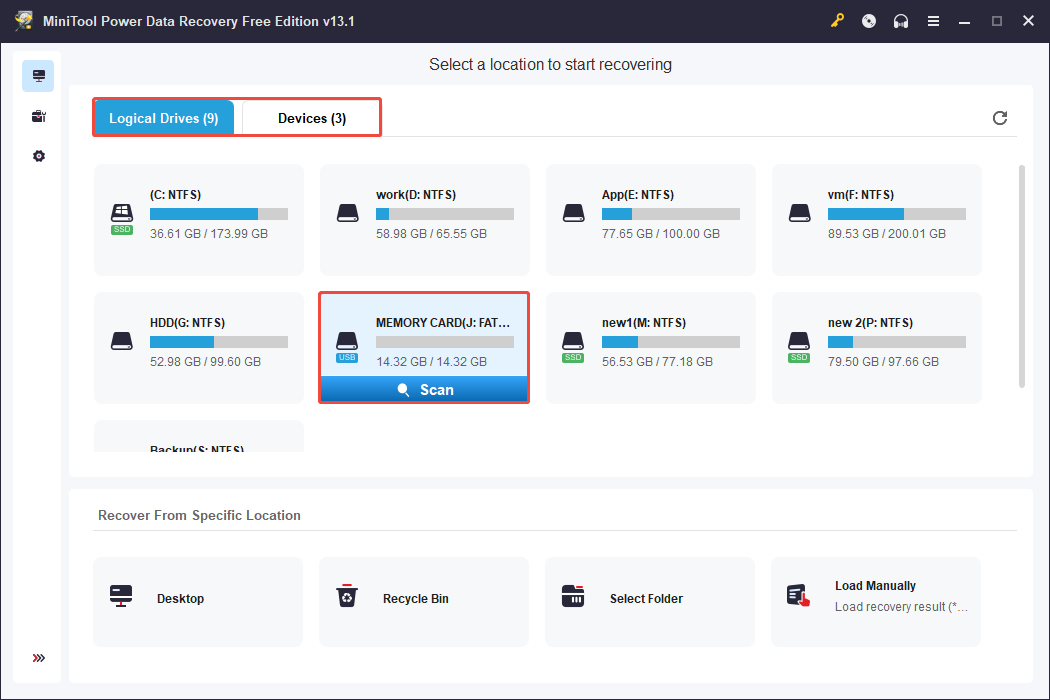
The scan duration will last for a few minutes. Please wait patiently until the scan process completes automatically.
Step 2. Find the Required Files
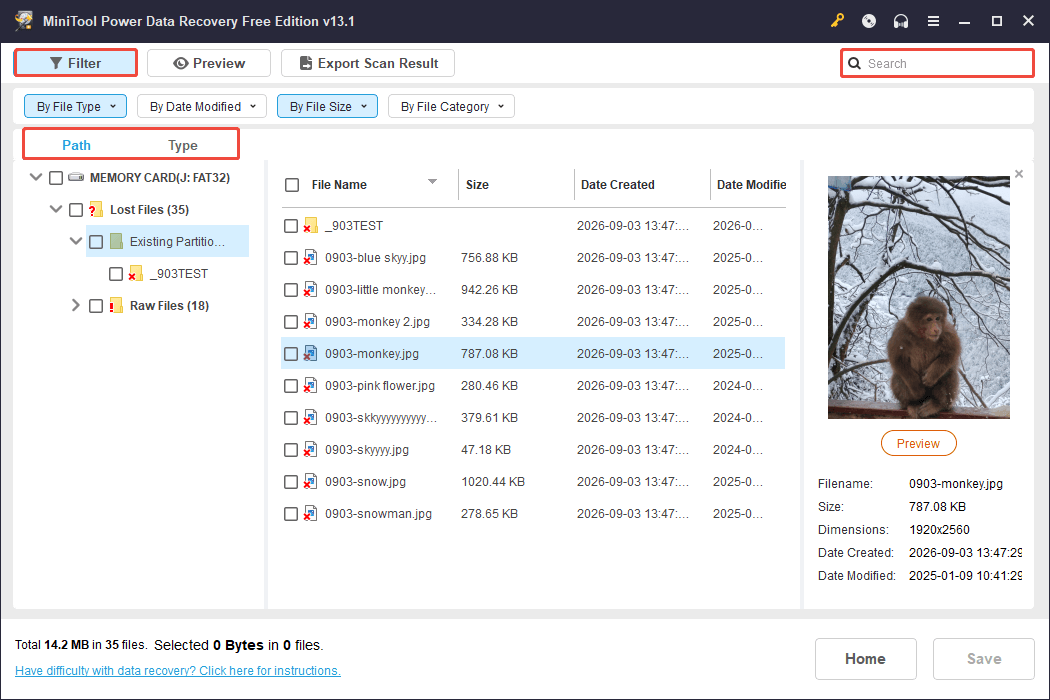
After scanning, all the found files are listed under the Path tab. If there are numerous files on the result page, you can use functions like Type, Filter, and Search to filter out unwanted files or locate the required files with certain conditions.
Step 3. Recover the Wanted Files
Select all the files you want to restore and click Save. In the prompt window, you should choose a new destination for those files. Saving files to the original path might overwrite the lost data.
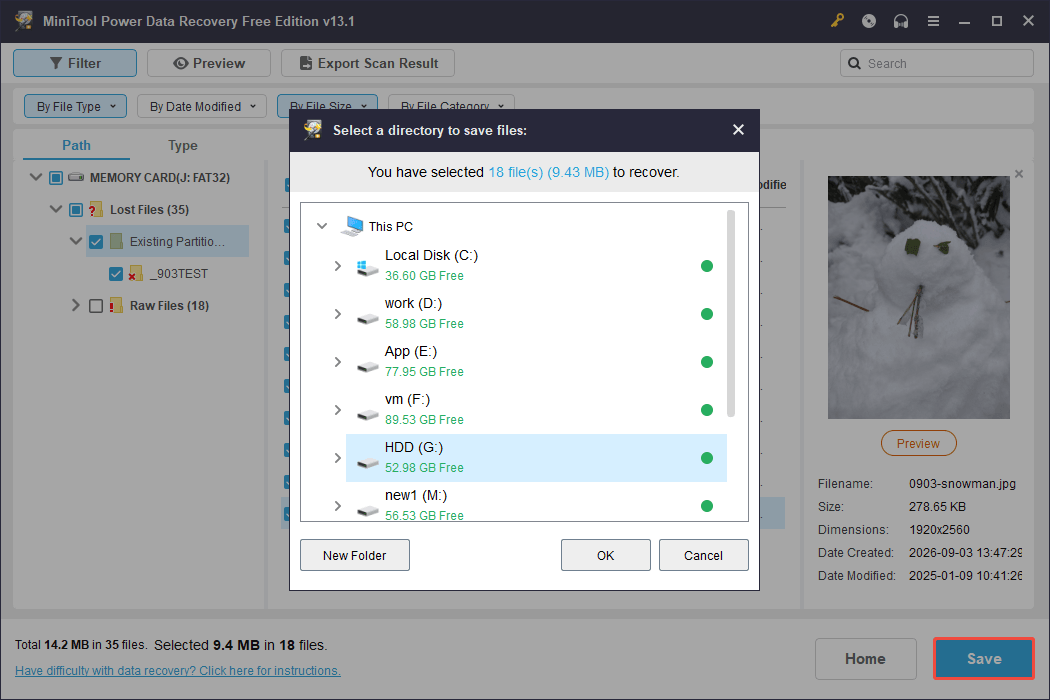
If you select files more than 1 GB, you should upgrade the software to an advanced edition to exceed the 1 GB free data recovery limit.
After rescuing files from the problematic SD card, you can start fixing the SD card error.
How to Fix Common SD Card Errors on Windows 11/10
The following methods can help resolve common SD card problems such as a write-protected SD card, missing drive letter, file system errors, or an SD card that needs to be formatted.
Keep reading to learn how to fix SD card errors.
Fix 1. Check the Write-Protection Switch
Applicable cases: SD card is write-protected, cannot write to SD card, cannot delete files from SD card.
If you can read files from the SD card but cannot delete, modify, or save files to it, the card may be write-protected.
A full-size SD card or SD adapter may have a physical lock switch.
Remove the SD card from your computer. Find the small Lock switch on the left or right side of the card or card adapter. Then slide the switch to the unlocked position.
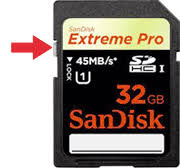
Image source: support-en.sandisk.com

Fix 2. Remove the Read-Only Attribute in DiskPart
Applicable cases: SD card is read-only, cannot write files to the SD card, cannot format the SD card because it is write-protected.
If Windows still treats the SD card as read-only after you have unlocked the physical switch, the disk may have a read-only attribute. You can use DiskPart to clear this attribute.
Step 1. Open Command Prompt as an administrator.
Step 2. Type the following commands and press Enter after each:
- diskpart
- list disk
- select disk X (replace X with the actual disk number of your SD card)
- attributes disk clear readonly
Reconnect the SD card and check whether you can now write data to it.
Fix 3. Add a New Drive Letter
Applicable cases: SD card not showing up in File Explorer, SD card detected but not accessible, SD card has no drive letter.
Sometimes Windows detects an SD card but does not assign it a drive letter. In this situation, the card may not appear in File Explorer even though it is recognized by the system.
Step 1. Open Disk Management.
Step 2. Right-click the SD card volume and select Change Drive Letter and Paths.
Step 3. Click Add if the card does not have a drive letter.
Step 4. Select Assign the following drive letter, choose an available letter, and click OK.
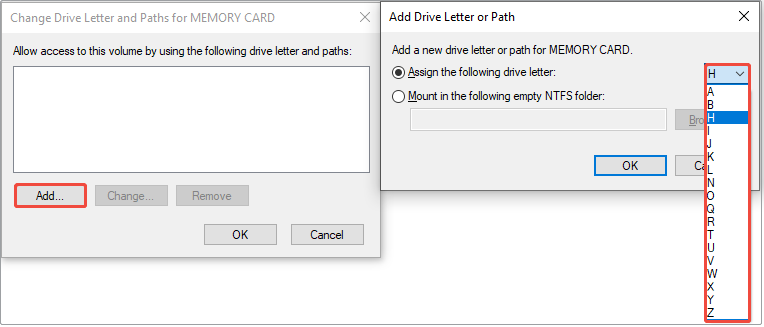
Fix 4. Repair File-System Errors with CHKDSK
Applicable cases: SD card is corrupted, SD card has file-system errors, SD card is not accessible, Windows reports errors when opening the SD card.
If the SD card is recognized by Windows but has file-system errors, CHKDSK can check the file system and repair certain logical errors.
How to fix corrupted SD cards using CHKDSK:
Step 1. Make sure the SD card has a drive letter.
Step 2. Open Command Prompt as administrator.
Step 3. Type the following command and press Enter. Replace H: with the actual drive letter of your SD card.
chkdsk H: /f
Wait for CHKDSK to complete the scan and repair process.
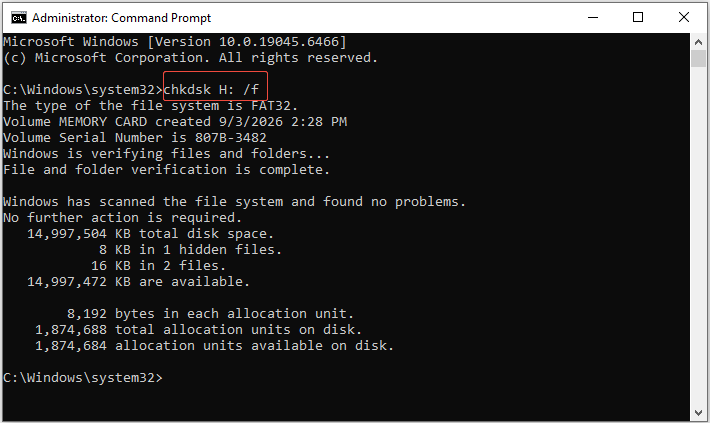

Fix 5. Format the SD Card
Applicable cases: SD card needs to be formatted, SD card has a corrupted file system, SD card cannot be used.
Formatting can recreate the file system and may resolve persistent SD card errors when the existing data is no longer needed or has already been recovered.
Step 1. In File Explorer, right-click the SD card and select Format.
Step 2. Select an appropriate file system. For example, exFAT is commonly used for SDXC cards, while FAT32 is used by many smaller-capacity SD cards.
Leave Quick Format selected unless you have a specific reason to use a full format.
Step 3. Click Start and confirm the operation.
Fix 6. Clean the Card
Applicable cases: SD card cannot be formatted, or the partition information is corrupted.
If an SD card has corrupted partition information and cannot be formatted or reused normally, you can use the DiskPart clean command to remove the existing partition and volume information. After cleaning the card, you can create a new partition and format it so that Windows can use the card again.
Step 1. Open Command Prompt as an administrator.
Step 2. Input the following commands and press Enter after each:
- diskpart
- list disk
- select disk x (replace X with the disk number of your SD card)
- clean
- create partition primary
- select partition 1
- format fs=fat32 quick
- assign
After completing these steps, open File Explorer and check whether the SD card can be accessed normally.
When Should You Replace an SD Card
An SD card should not necessarily be replaced just because it shows one error. However, replacement is worth considering when:
- The card repeatedly becomes corrupted.
- Files become inaccessible again after formatting.
- The card frequently connects and disconnects.
- The card becomes read-only without an obvious reason.
- The card is not detected by multiple working readers.
- The card has visible physical damage.
- Data stored on the card becomes corrupted repeatedly.
How to Prevent SD Card Errors
You can reduce the risk of future SD card problems with a few basic practices:
- Safely eject the card before removing it from a computer.
- Avoid removing the card while files are being written.
- Use a reliable card reader and adapter.
- Avoid filling the card when possible.
- Use the appropriate file system for the device.
- Use a suitable SD card for demanding applications such as continuous video recording.
Conclusion
SD card errors can result from anything from a simple connection problem to file-system corruption or physical card failure.
If the SD card contains important data, use data recovery software to recover the files. After the data is safe, troubleshoot the card by checking the reader, assigning a drive letter, repairing logical errors, or formatting the card.
If an SD card continues to fail across multiple devices, replace it.
If you have any questions about using MiniTool software, feel free to let us know via [email protected].
SD Card Error FAQ
Back up or recover important data as soon as possible and consider replacing the card.
About The Author

Position: Columnist
Shirley holds a bachelor’s degree in English and has been an editor at the MiniTool Team for many years. She specializes in IT-related content, with a focus on data recovery, file backup, disk management, and other technical topics. She is committed to delivering clear, accurate, and practical solutions to help users resolve common computer issues.
User Comments :